
Why Modern Cars Drain Batteries Faster Than Older Vehicles
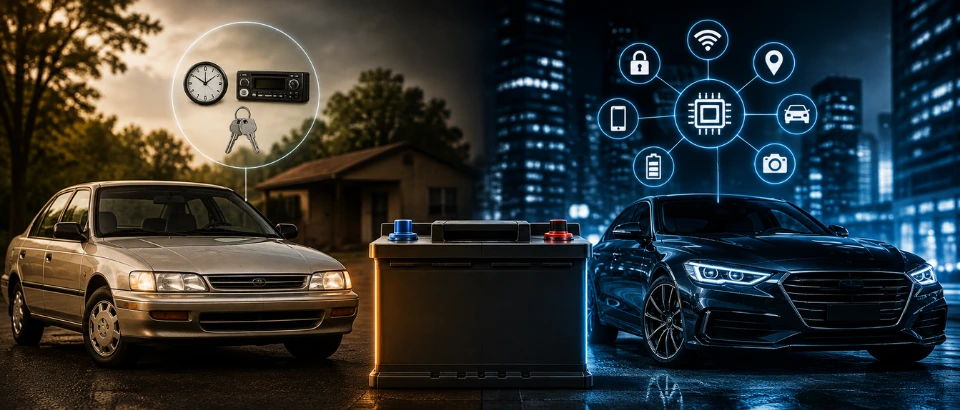
Park a 1998 Corolla for three weeks and it will probably still start. Park a 2022 continental sedan for the same three weeks and there is a fair chance you will be calling someone for help.
That gap confuses a lot of owners, and it usually gets blamed on poor battery quality. Most of the time the battery is fine. The car is asking far more of it than an older car ever did, both while you drive and while it sits in the carpark doing nothing.
Modern cars never fully switch off
Turning the key off in an older car really did shut almost everything down. A clock, a radio memory, and that was about it.
A car built in the last ten to fifteen years shuts down in stages, and several systems stay awake or wake themselves periodically. VARTA, which supplies batteries to most major European carmakers, puts it plainly in its battery knowledge notes: today’s car batteries do far more than start the engine, because they also power control units, the entertainment system and the digital dashboard during engine-off periods.
The list of things drawing power in a modern car is long:
- Body and engine control modules that hold settings in memory and sit in a low power sleep state rather than switching off completely.
- Keyless entry and keyless go. The car listens for the fob, and the fob keeps talking back.
- Alarm, immobiliser and tilt sensors running around the clock.
- Telematics and connected features that check in with a mobile network or a phone app.
- Parking sensors, cameras and driver assistance modules that need to boot and calibrate.
- Memory functions for seats, mirrors, climate and audio.
- Aftermarket additions such as dashcams with parking mode, built to keep recording after the car is off.
None of these is a fault. They are all doing their job. The point is that the sum of them is much larger than it used to be.
What parasitic drain actually means
Parasitic drain, also called key-off draw or quiescent current, is the electricity a vehicle uses while parked and switched off.
Every car has some. It is measured in milliamps, and the acceptable figure is set by the vehicle manufacturer, which is why no single number applies to every car. Modern vehicles with more modules sit at the higher end, and that is normal.
Drain becomes a problem in three situations.
Normal draw, not enough driving. The battery loses a little every day it sits. If the driving in between is too short to put that back, the state of charge keeps sliding downward.
A module that will not sleep. If one control unit stays awake after the car locks, or a relay sticks closed, the draw can be many times the design figure. A car that once sat happily for two weeks now goes flat in three days.
A wiring or accessory fault. DENSO’s charging system guidance is direct about this: non factory accessories can overburden the charging system and cause premature failure, and poor earth points, loose connections or incorrect wiring during installation cause problems on their own. A cheaply installed dashcam or audio upgrade is a common culprit.
Finding an abnormal draw takes proper equipment and a set order of tests. Modern cars take a long time to fully go to sleep, and readings mean nothing until they do. Pulling fuses one at a time wakes modules back up and can hide the fault you are chasing.
Battery technology changed to keep up
Not every modern car uses a special battery. Plenty still run a conventional flooded lead acid battery, often called SLI. But two other types are now common, and they exist because of the demands above.
EFB, or Enhanced Flooded Battery. VARTA describes EFB as a further development of the conventional lead acid battery, with low internal resistance and roughly twice the charging cycles of a standard starter battery. It suits cars with entry level start-stop, and cars without start-stop that face heavy urban traffic or carry a lot of electrical equipment.
AGM, or Absorbent Glass Mat. The electrolyte is held in a glass fleece rather than sitting as free liquid. AGM handles repeated shallow discharge and recharge far better, which is exactly what a start-stop system does at every junction, and it keeps the car’s electrics running during those engine-off pauses.
One rule catches people out. According to VARTA’s comparison of EFB and AGM batteries, a car fitted with AGM must be replaced with AGM. Moving from EFB up to AGM is acceptable and sometimes advisable. Going the other way, or dropping back to a plain flooded battery, is not.
Why the wrong battery causes real problems
Modern batteries are not simply connected and forgotten. EFB and AGM batteries are monitored by a battery sensor and work closely with the vehicle’s battery management system. The control unit tracks energy demand along with charge state and energy throughput, then adjusts charging to match.
Fit the wrong type and the car keeps charging as though the correct one were installed. VARTA lists the consequences: the start-stop system starts misbehaving, comfort functions fail, and battery service life is cut short.
A second step gets skipped often. Vehicles with advanced energy management systems, which VARTA identifies as including BMW, Mercedes and the VAG group, need a battery registration procedure carried out with diagnostic tools after replacement. Without it, the car keeps treating a new battery as an old one. Requirements vary by make and model, so ask before the job starts rather than after. Our page on car battery products and brands covers the conventional, EFB and AGM options available here.
Why older cars behaved differently
Older vehicles had fewer control modules, simpler alarms, no telematics, and very little running while parked. Their demand while stationary was genuinely tiny, so a healthy battery could sit for weeks.
That said, older cars did not automatically get longer battery life. They used older chemistry, often needed topping up with distilled water, and faced the same enemies batteries face today: heat, vibration and sitting partly discharged. Plenty of older cars ate batteries too. What changed is not battery quality but the size of the load and how little margin a modern electrical system leaves.
What Singapore conditions add
Heat. VARTA notes that hot weather speeds up the chemical processes inside a car battery, which increases self-discharge and corrosion. A battery parked in an open-air carpark here is warm almost all the time, so it loses charge faster while doing nothing and ages faster internally.
Short journeys. The Automobile Association of Singapore points out that frequent short trips are a common reason batteries start giving trouble, because the power used to start the engine cannot be fully replaced during a short drive. Twenty minutes to the office, twenty minutes home, a supermarket run at the weekend. Every start is a big withdrawal and every short trip a small deposit. VARTA makes a related point in its guidance on choosing a battery for short distance driving, noting that recharging properly while driving is a real challenge on short journeys.
Traffic. Crawling along keeps the engine near idle, where the alternator turns slowly, while the aircon blower, compressor clutch, condenser fans, lights and screens all draw current.
Cars that sit. Second cars and weekend cars are common here, and on a modern vehicle with a high key-off draw, a fortnight of standing still can leave the battery too weak to crank.
Accessories. Parking-mode dashcams are close to standard locally, and they draw power while the car is off by design. Most are fine. The troublesome ones are wired without a reliable low voltage cut-off, or fitted with a poor earth.
Warning signs your battery is struggling
Treat two or more of these appearing together as a reason to get things tested:
- Slower cranking, especially first thing in the morning.
- Repeated flat batteries, particularly after the car has been parked a few days.
- Start-stop stops working. On cars that have it, this is often the earliest warning, because the system will not shut the engine down if it cannot guarantee a restart.
- Electrical oddities, such as dashboard warnings appearing and clearing, infotainment rebooting, or slow windows and central locking.
- Needing a jump start more than once.
None of this proves the battery is finished. Slow cranking can come from a failing starter motor, and repeated flat batteries often come from a charging fault, which is the difference our guide to bad battery and bad alternator symptoms walks through. If you have already fitted a new battery and the problem persists, our post on what to check when the car will not start with a new battery covers the usual causes. VARTA also warns that a simple voltage reading is not enough to judge state of health.
Practical ways to avoid the problem
- Drive the car properly now and then. A longer continuous run gives the alternator time to replenish the battery instead of just covering the starting cost. If the car mostly does short hops, this matters more, not less.
- Switch things off before you switch off. Aircon on full, headlights and a boot full of chargers all draw current around shutdown and make the next start harder.
- Check what your dashcam is doing. Find out whether parking mode has a voltage cut-off and whether it is set sensibly. If the car will sit for a week, switch parking mode off.
- Have accessory wiring done properly. Most accessory-related battery complaints trace back to the installation, not the device.
- Get the battery tested rather than guessed. A proper load or conductance test tells you state of health, and VARTA advises treating the battery as part of routine servicing, not something you think about after a breakdown.
- Use the correct replacement type. If the car came with AGM, it needs AGM. If it needs registration, it needs registration.
- Stop repeatedly jump starting the same car. A jump start gets you moving, it does not repair anything. Needing one twice in a month means something is wrong, and our page on car battery jump start explains when a jump is the right call.
There is no universal replacement interval either. VARTA’s own position is that battery life depends on condition, usage and upkeep, and that published figures are approximate guidelines rather than a schedule.
When to get it looked at
If your car keeps going flat, the sequence that saves money is simple. Test the battery first. If the battery is healthy and properly charged, check the charging system next, because a weak alternator will flatten a good battery over and over. If both are fine, you are looking at an abnormal key-off draw and that needs proper diagnosis.
Swift Battery Specialist has been doing onsite work across Singapore since 2016, 24 hours a day and on public holidays. We test the battery on the spot, carry branded batteries for most makes and models, and offer free testing on the charging system, so a fault in the car alternator gets ruled in or out before you pay for a battery you may not need. Where replacement is the right answer, our onsite change car battery service comes to you, and batteries we install carry a one year warranty on petrol cars and six months on diesel.
Call +65 8858 9959 and describe what the car is doing, including how long it sits between drives. That last detail tells us more than most people expect.
Frequently asked questions
Q: Why does my car battery drain while parked?
A: Every modern car uses a little power while parked to keep control modules, the alarm, keyless entry and memory settings alive. That is normal and designed for. Drain becomes abnormal when a module fails to sleep, a relay sticks, or an accessory such as a dashcam keeps drawing without a proper cut-off. The other common cause is normal draw combined with too little driving to replace it.
Q: Why does my new car battery keep going flat?
A: A new battery going flat usually points to something outside the battery. The three most common reasons are a charging system that is not putting enough back, an abnormal key-off draw, and short trips that never fully recharge it. Fitting the wrong battery type, or skipping battery registration on a car that requires it, can also cause early failure.
Q: Can a dashcam drain a car battery?
A: It can, if it records while parked without a reliable low voltage cut-off, or if it was wired in badly. A dashcam used only while driving draws nothing once the car is off. Before blaming the camera, check how it is powered and whether the car is driven enough to recover what it uses.
Q: Do modern cars really use more power when parked than older cars?
A: Generally yes, because they carry far more control modules, security systems and connected features that stay partly awake. How much more depends entirely on the model and its equipment, so a basic modern hatchback and a fully loaded luxury car are very different cases.
Q: How long can a modern car sit without being driven?
A: There is no single answer. It depends on the vehicle’s key-off draw, the battery’s size and condition, the temperature and what accessories are fitted. A healthy battery in a car with modest electronics can manage several weeks, while a tired battery in a car with high draw and a parking-mode dashcam may struggle after a few days. If your car regularly sits for long stretches, get the battery tested rather than finding out the hard way.


