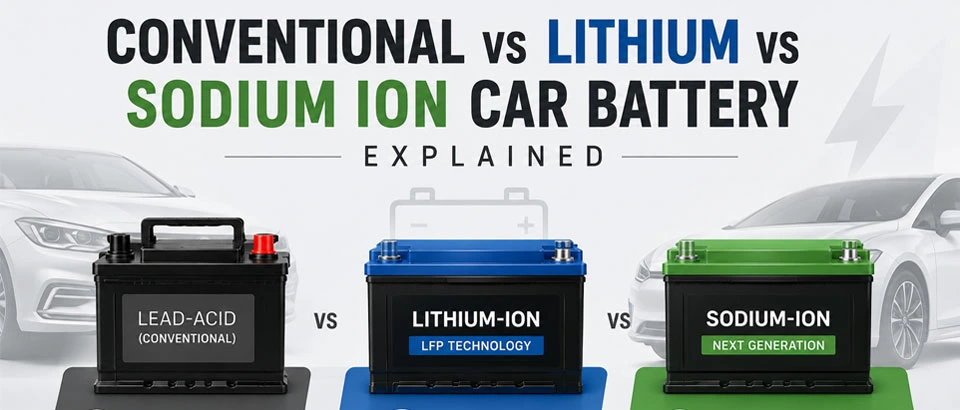
Conventional vs Lithium vs Sodium Ion Car Battery Explained
The battery market has changed more in the last ten years than in the previous century. Conventional lead-acid batteries still power the majority of petrol and diesel cars on the road, but lithium-ion technology has reshaped how electric and hybrid vehicles are built, and sodium-ion batteries are beginning to enter the picture as a viable alternative for affordable EVs.
If you are choosing a replacement battery, evaluating an EV purchase, or simply want to understand what sits under your bonnet, knowing how these three chemistries differ gives you a meaningful advantage.
Key Takeaways
- Lead-acid batteries remain the standard for petrol and diesel vehicles: proven, affordable, and widely available.
- Lithium-ion batteries offer far greater energy density and lifespan but at a higher upfront cost.
- Sodium-ion batteries use no lithium or cobalt, making them cheaper to produce and better suited to low-cost electric vehicles.
- Heat accelerates lead-acid degradation faster than any other chemistry.
- Lithium-ion battery pack costs have dropped nearly 90% since 2010, making EVs increasingly competitive.
- For a standard petrol car, a quality AGM battery remains the most practical choice in 2025.
Conventional Lead-Acid Batteries
Lead-acid technology has been around since 1859, and despite its age, it still accounts for the majority of automotive starting batteries in service today. The chemistry is straightforward: lead plates sit in a sulfuric acid electrolyte, and the reaction between them releases electrical energy to start your engine.
There are four main variants worth knowing:
- Flooded (Wet Cell): The oldest and cheapest type. Requires occasional maintenance and can spill if tilted.
- AGM (Absorbent Glass Mat): The electrolyte is absorbed into fibreglass mats. Spill-proof, vibration resistant, and required by most modern cars with start-stop systems. More expensive but lasts significantly longer.
- EFB (Enhanced Flooded Battery): A mid-tier option for basic start-stop vehicles. Better cycle life than standard flooded but not as capable as AGM under heavy electrical loads.
- Gel: Uses gel electrolyte, handles heat and deep discharge reasonably well, but charges slowly and is sensitive to overcharging.
The main weakness of lead-acid in hot climates is heat sensitivity. Research consistently shows that for every 10°C rise above 25°C, lead-acid battery life is approximately halved. Under-bonnet temperatures in tropical environments regularly exceed 50°C, which explains why battery degradation from heat is one of the most common reasons drivers need an early replacement.
| Spec | Lead-Acid (AGM) | Lithium-Ion (LFP) | Sodium-Ion |
|---|---|---|---|
| Energy Density | 30-50 Wh/kg | 90-130 Wh/kg | ~160 Wh/kg |
| Cycle Life | 400-700 | 2,000-4,000+ | ~2,000 |
| Lifespan | 3-5 Years | 8-15 Years | 8-12 Years (Projected) |
| Cold Weather | Poor | Good | Excellent |
| Heat Resistance | Poor | Good (with BMS) | Good |
| Cobalt/Lithium | No | Yes (LFP: No Cobalt) | None |
| Upfront Cost | Low | High | Medium-Low (Projected) |
Lithium-Ion Batteries
Lithium-ion batteries power every mainstream electric vehicle on the market today. Instead of acid and lead plates, they move lithium ions between a cathode and anode during charging and discharging. This process is more efficient, more energy-dense, and generates less heat internally than lead-acid chemistry.
“Lithium-ion” actually describes a family of chemistries:
- LFP (Lithium Iron Phosphate): Used by Tesla standard range models and BYD across most of its lineup. Highly stable, long cycle life, and more heat-tolerant than other lithium chemistries. Lower energy density than NMC but widely preferred for longevity.
- NMC (Nickel Manganese Cobalt): Higher energy density, enabling longer EV range. Used by BMW, Hyundai, and others. Costs more due to cobalt content and is slightly more temperature-sensitive than LFP.
- NCA (Nickel Cobalt Aluminium): The highest energy density of the three. Used in some Tesla and Panasonic cells. Demands precise thermal management.
The cost trajectory of lithium-ion has been remarkable. According to the International Energy Agency (IEA), battery pack prices fell from over $1,200 per kWh in 2010 to approximately $139 per kWh in 2023 — a reduction of nearly 90% in thirteen years.
Source: International Energy Agency, Global EV Outlook 2024.
For drivers with petrol cars, 12V lithium iron phosphate replacement batteries are available as a direct swap for the conventional battery. They are lighter, last longer, and hold charge better during extended non-use periods, but cost two to three times more than an equivalent AGM. Whether that premium makes sense depends on how long you plan to keep the vehicle.
Sodium-Ion Batteries
Sodium-ion technology works on the same fundamental principle as lithium-ion: ions move between electrodes to store and release energy. The critical difference is that sodium replaces lithium as the charge carrier.
Sodium is the seventh most abundant element on Earth and far more evenly distributed geographically than lithium. This makes sodium-ion cells cheaper to produce and removes the cobalt and lithium dependency that creates supply chain and ethical sourcing concerns for current EV batteries.
CATL unveiled its first-generation sodium-ion battery in 2021, announcing an energy density of 160 Wh/kg, an operating temperature range of -40°C to 80°C, and the ability to charge to 80% in 15 minutes. By 2024, BYD’s entry-level Seagull model was offered with a sodium-ion battery option in China, marking the technology’s first meaningful commercial deployment.
Source: CATL Official Technical Release, 2021.
As of 2025, sodium-ion vehicles are not yet available in most markets outside China. But the technology is advancing rapidly and is specifically targeting the affordable EV segment where cost matters more than maximum range.
| Spec | Lead-Acid (AGM) | Lithium-Ion (LFP) | Sodium-Ion |
|---|---|---|---|
| Energy Density | 30-50 Wh/kg | 90-130 Wh/kg | ~160 Wh/kg |
| Cycle Life | 400-700 | 2,000-4,000+ | ~2,000 |
| Lifespan | 3-5 years | 8-15 years | 8-12 years (projected) |
| Cold Weather | Poor | Good | Excellent |
| Heat Resistance | Poor | Good (with BMS) | Good |
| Cobalt/Lithium | No | Yes (LFP: no cobalt) | None |
| Upfront Cost | Low | High | Medium-Low (projected) |
Which Battery Type Is Right for Your Vehicle?
Petrol or diesel car: Stick with a quality AGM or EFB battery that matches your vehicle’s specification. These vehicles are engineered around lead-acid chemistry, and the car battery replacement process is straightforward when done with the correct specification.
Hybrid vehicle: Most hybrids run two separate batteries: a conventional 12V battery for accessories and starting, and a high-voltage lithium-ion or nickel-metal hydride pack for the electric drive system. Understanding which one is failing matters before any hybrid battery service.
Electric vehicle: Your battery chemistry was chosen by the manufacturer. Focus on protecting longevity: keep daily charge between 20-80% where possible, avoid sustained high-temperature parking, and ensure the thermal management system is serviced correctly.
Future EV buyer: Sodium-ion will become relevant for budget-tier EVs over the next 2-3 years. For those prioritising sustainability, it pairs well with the broader shift toward eco-friendly battery options that minimise mining impact.
Conclusion
Lead-acid, lithium-ion, and sodium-ion batteries represent three distinct generations of automotive power, each suited to a different vehicle type and use case. For most drivers today, the right choice is clear: a quality AGM battery for petrol cars, lithium-ion chemistry for EVs, and sodium-ion as a technology to watch for affordable electric mobility in the near future.
If your current battery is due for a replacement or you are unsure which specification is right for your car, our car battery replacement service covers all major makes and models, with on-site fitting available.


