
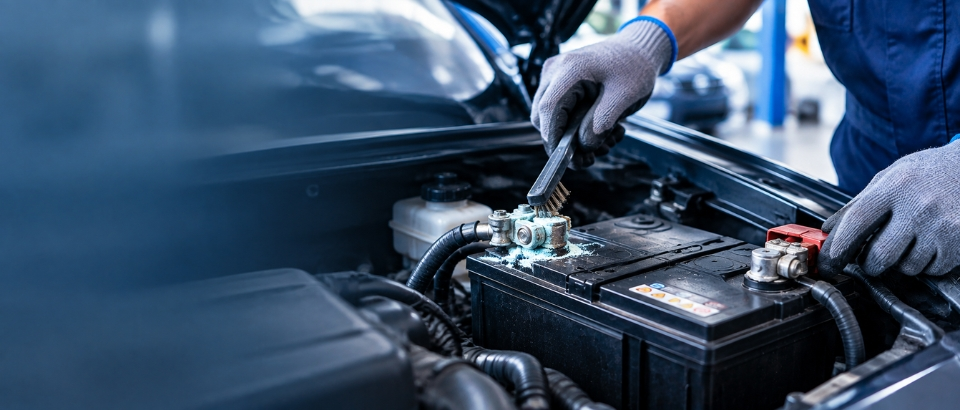
Car Battery Terminal Corrosion: What Causes It and How to Prevent It
Open your bonnet and look at the two posts on top of the battery. If you see a crusty white or bluish-green build up around either of them, that is terminal corrosion, and it does more harm than it looks.
Plenty of drivers notice it, decide it is only dirt, and shut the bonnet again. A few weeks later the car cranks slowly or refuses to start, and the battery gets blamed for a problem that was never really about the battery.
What the build up on your terminals is
The terminals are where the battery connects to the rest of the car. Everything the electrical system needs passes through those two small joints.
Many lead acid car batteries can vent small amounts of gas, particularly while charging. Moisture, battery vapour and the metals around the connection can then react over time, leaving the familiar crusty deposit around the terminals.
You are also joining two different metals. The battery posts are usually lead, while the cable clamps are often a different metal or alloy. As Battery University notes in its material on corrosion, terminal corrosion often shows up as a white powder produced by oxidation between two different metals connecting the poles, and it can eventually lead to an open electrical connection. The same source points out that using lead connecting terminals, the same material as the battery post itself, solves most corrosion problems.
So the deposits come from acid vapour, moisture and dissimilar metals reacting together. The colour hints at which metal is involved. Whitish or greyish powder usually points to lead or zinc compounds, while a blue or green crust normally means copper in the clamp or cable ends is corroding.
What corrosion does to your car
Corrosion products do not conduct electricity well. That single fact causes everything else.
It adds resistance where you can least afford it. Starting an engine draws a very large current through those two joints. A corroded connection resists that flow, so voltage drops across the terminal instead of reaching the starter. The engine cranks slowly even though the battery may be in good condition.
It interferes with charging. The same joint carries current in the other direction when the alternator is recharging the battery. VARTA makes this point directly in its guidance on correct battery care, explaining that cleaning the terminals and connections prevents corroded contacts, minimises contact resistance, and improves both charging and cold start capability.
That second effect is the one people miss. A corroded terminal can leave the battery slightly undercharged after every drive, and over months that shortens its life on its own, quite apart from the starting trouble.
It causes intermittent electrical faults. A poor connection may work fine at low current and fail under load, showing up as flickering lights, an infotainment system that resets, or warning lights that come and go.
It can break the connection completely. Left long enough, the build up separates the clamp from the post electrically and the car goes dead.
VARTA also notes that a clean area around the battery helps limit self discharge, because dirt combined with moisture near the terminals can promote leakage currents. A grimy, damp battery top can slowly drain a battery even when everything else is fine.
Why one terminal corrodes and not the other
Sometimes one terminal looks perfectly clean while the other is covered in corrosion. That does not automatically tell you what is wrong.
One-sided corrosion can happen for several reasons. Moisture may be getting into one connection, a clamp may not be sitting properly, or there may be leakage around one of the battery posts. Excessive battery venting or a charging system problem can also contribute.
So treat the affected terminal as a clue, not a diagnosis. If the same side becomes heavily corroded again soon after cleaning, it is worth checking the battery, terminal connections and alternator rather than simply cleaning it again.
Our guide on the difference between a failing battery and a failing alternator explains some of the other symptoms to look for.
The main causes in everyday driving
Normal ageing. A little corrosion can develop as a battery gets older. Years of heat, vibration and everyday use take their toll on the battery, seals and connections. Heavy corrosion, or corrosion that keeps coming back, is another story and should be checked.
Loose or poorly fitted clamps. A clamp that is not tight leaves a gap where vapour and moisture collect, and engine vibration wears the contact surfaces. This is one of the most common preventable causes.
Overfilling or a leaking battery. On older serviceable batteries, filling above the correct level pushes electrolyte out through the vents during charging. A cracked case or damaged post seal does the same.
Overcharging from a charging fault. A failed voltage regulator pushing charging voltage too high forces heavy gassing, and that vapour has to go somewhere. Worth ruling out with onsite alternator testing if corrosion returns quickly after cleaning.
A dirty or damp engine bay. Dust, oil and moisture around the battery give corrosion a better chance to get started.
An old battery near the end of its life. Seals degrade with age and heat, so venting increases.
Why Singapore’s climate makes it worse
Two local conditions push terminal corrosion along faster than in cooler, drier places.
Humidity. Corrosion is an electrochemical reaction and it needs moisture to proceed. Singapore’s air supplies that generously all year. Cars in open-air carparks, and cars washed often, get repeated wetting around the battery.
Heat. Warm temperatures speed up chemical activity inside and outside the battery. Higher under-bonnet temperatures increase venting, so more acid vapour reaches the terminals, and the corrosion reaction itself runs faster once started.
None of this means corrosion is unavoidable in Singapore. It just makes regular checks more worthwhile. Take a quick look at the terminals every few months, especially if the car spends a lot of time parked outdoors.
Warning signs beyond the visible crust
Corrosion often hides under the clamp or a rubber terminal cover, so the top looks clean while the joint underneath is not. Watch for:
- Slow or inconsistent cranking, particularly a start that varies from day to day rather than getting steadily worse.
- A single click or nothing at all when you turn the key, while the dashboard lights stay bright.
- Headlights dimming noticeably when you try to start.
- A battery that tests healthy but the car still starts badly, which is a classic sign the problem is in the connection rather than the battery.
- Warning lights that come and go without a clear pattern.
- A faint sulphur or rotten egg smell near the battery, which suggests it is venting more than it should and needs proper attention rather than a wipe down.
That fourth point matters most. If a new battery was fitted recently and the car is still hard to start, dirty or loose terminals are one of the first things to check. Our post on what to check when a car will not start with a new battery covers the other common causes.
Cleaning terminals safely
If the battery is swollen, cracked, leaking, unusually hot or giving off a strong rotten egg smell, stop there. Do not try to clean or disconnect it yourself. The battery needs to be properly inspected.
Safety first. Wear eye protection and gloves, since the deposit is acidic and irritates skin and eyes. Keep flames away, because vented hydrogen is flammable. Remove rings and watches so you cannot bridge a terminal to the bodywork.
Disconnect in the right order. The negative terminal comes off first and goes back on last. That way, if a spanner touches the body while you work on the positive side, there is no complete circuit to arc through. VARTA’s installation guidance puts the same rule first for this reason.
Know what disconnecting does. On modern cars, cutting power can clear stored settings and some models need a reset afterwards. If your car has start stop or an advanced energy management system, check before disconnecting anything.
Clean, dry and protect. The corrosion is neutralised and removed, the post and the inside of the clamp are cleaned back to bright metal, and everything is dried. The joint is reassembled snugly, not overtightened, then protected with a proper terminal grease.
If that sounds like more risk than you want, that is a fair conclusion. It is a small job for someone with the right equipment, and it comes with a proper look at the battery and charging system at the same time.
How to keep corrosion from coming back
- Check the terminals every few months. A quick look catches build up while it is still cosmetic. In this climate, twice a year is a sensible minimum.
- Keep the clamps properly tight. Snug and secure, without forcing them. Loose connections cause more corrosion problems than almost anything else.
- Keep the battery top clean and dry. Wipe away dust and oil film. A clean surface limits the leakage currents that quietly drain charge.
- Use a proper terminal protector. A purpose made dielectric grease or terminal spray after cleaning creates a barrier against moisture and vapour. Petroleum jelly works reasonably, but a dedicated product holds up better in heat.
- Fix the cause if it keeps returning. Corrosion back within weeks is telling you something, usually a charging fault, a leaking battery, or a clamp that was never properly tightened.
- Replace an old battery that vents heavily. Once seals are past their best, cleaning is a losing battle. Choosing the right replacement type matters too, and our page on battery brands and types explains conventional, EFB and AGM units.
- Do not rely on repeated jump starts. If corroded terminals are why the car will not start, a car battery jump start may not even work well, since the poor connection resists current both ways.
When to Call a Car Battery Specialist
Light powder that wipes away and stays away is routine maintenance. These situations are worth a professional look.
- Heavy build up that has been there a while, especially if the cable ends are affected as well as the posts.
- Corrosion that returns quickly after cleaning, which may point to a charging fault, battery leakage or a problem with the terminal connection.
- Any sign the battery case is swollen, cracked or wet around the posts.
- Starting problems that persist after cleaning, which means the battery or charging system needs testing.
Swift Battery Specialist has been doing onsite work across Singapore since 2016, 24 hours a day including public holidays. We check the battery, terminals and connections where your car is parked, and provide free alternator testing if we suspect the charging system may be part of the problem. If the battery has reached the end of its life, our 24 hour onsite car battery replacement comes to you, with a one year warranty on petrol cars and six months on diesel.
Call +65 8858 9959 and describe what you are seeing, including which terminal is affected and whether the problem has come back after cleaning. Those details usually narrow it down quickly.
Frequently asked questions
Q: What causes corrosion on car battery terminals?
A: It comes from acid vapour and hydrogen venting during charging, reacting with moisture and the metals at the terminal. Because the posts and cable clamps are often different metals, oxidation between them produces the powdery deposit. Loose clamps, overcharging, a leaking battery, worn seals on an old battery and a damp dirty engine bay all speed it up.
Q: Can corroded battery terminals stop a car from starting?
A: Yes. Corrosion products conduct electricity poorly, so they add resistance exactly where the car needs to pass a very large current to the starter. The engine may crank slowly, click once, or do nothing at all while the dashboard lights still look normal. In advanced cases the connection can fail completely.
Q: Is battery terminal corrosion dangerous to touch?
A: The deposits are acidic and irritate skin and eyes, so gloves and eye protection are sensible. The bigger hazard is the battery itself, since charging produces flammable hydrogen gas and a shorted terminal can throw a large spark. Keep flames away and remove rings and watches before working near a battery.
Q: Why does only one of my battery terminals corrode?
A: One terminal can corrode more than the other because of moisture, a poor connection, battery venting or leakage around the post. It does not automatically mean the alternator is overcharging or undercharging. If the same terminal keeps developing heavy corrosion after cleaning, have the battery, connections and charging system checked.
Q: Will cleaning the terminals fix a weak battery?
A: Only if the connection was the real problem. Cleaning restores a proper contact and can transform starting on a car with a genuinely healthy battery. It cannot restore capacity to an old battery that is already failing, and it cannot fix a charging fault. If the car still starts poorly with clean, tight terminals, the battery and charging system both need testing.
Q: How often should battery terminals be checked in Singapore?
A: Given the humidity and heat, a visual check every few months is reasonable, and at least twice a year for most drivers. It also makes sense to have them inspected whenever the battery is tested or the car is serviced, since a proper check covers the condition and tightness of the connections, not just the battery.


