
What Is Battery Sulfation and How Does It Affect Your Car?
Most car batteries do not die suddenly. They fade for months while the owner keeps saying the car is “a bit slow to start lately”, and then one morning it does not start at all.
That slow fade has a name. It is called sulfation, and it is one of the most common reasons car batteries in Singapore give up earlier than they should. The frustrating part is that it is largely preventable once you know what causes it.
What sulfation actually is
One basic fact first. Inside a lead acid car battery are lead plates sitting in a mix of sulfuric acid and water, called the electrolyte. Electricity comes from a chemical reaction between the plates and that acid.
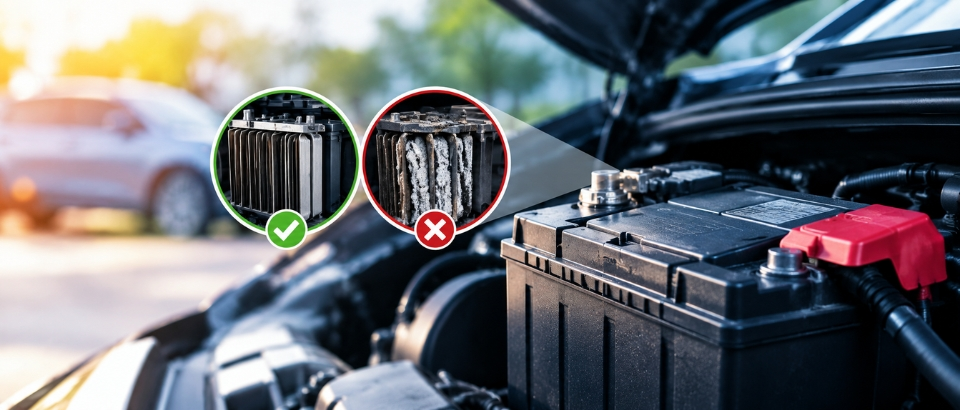
Every time the battery gives out power, some lead reacts with the acid and forms a soft substance called lead sulfate on the plates. This is normal and happens every time you start the engine. When the battery is recharged properly, the reaction runs backwards: the lead sulfate breaks up, returns into the electrolyte, and the plates go back to how they were.
Sulfation is what happens when the second half of that cycle does not finish. As Battery University explains in its guidance on sulfation, small sulfate crystals form during normal use and are harmless, but when a battery is deprived of a full charge for a long period, the soft lead sulfate turns into a stable crystalline form that settles on the plates. Those crystals grow larger and reduce the active material the battery relies on.
Put simply, the soft coating hardens into crystals that will not dissolve again.
Why hardened crystals ruin performance
The plates are where the work happens. Their surface area is what lets the battery deliver a big burst of current to crank the engine. When hard crystals build up, they block that surface. Battery diagnostics makers describe the effect clearly: the hardened crystals block the active material on the plates and stop ions passing between them, so the conductive area shrinks and the battery’s ability to hold a charge deteriorates.
Three things follow from that, and they all show up in daily driving.
Less capacity. The battery holds less energy than it used to, sometimes only a fraction of its rating.
Higher internal resistance. The battery struggles to push out current quickly. Cranking gets slower even when a voltmeter shows a reasonable reading.
Poor charge acceptance. This is the cruel part. A sulfated battery does not take a charge properly either, so driving does not fix it. The problem feeds itself.
There is also a trap for anyone testing with a basic meter. A sulfated battery can show healthy voltage while holding almost no usable energy. Battery maker VARTA makes the same point, noting that a simple voltage check is not enough to judge a battery’s true state of health.
Soft sulfation and hard sulfation
Not all sulfation is permanent, and the difference matters.
Soft, or reversible sulfation is the early stage. The crystals are still small and loose. A battery left partly discharged for a short while often falls into this group, and a proper charging routine with the right equipment can sometimes clear it.
Hard, or permanent sulfation sets in when the battery has been at a low state of charge for weeks or months. Battery University is honest about the outlook: at that stage no reliable form of restoration is available.
You will see products advertised as desulfators that claim to pulse a battery back to health. Treat those claims carefully. The same source notes that such devices may reduce sulfation on a healthy battery but cannot reliably reverse the condition once established, and that random pulses or a blind overcharge can harm the battery by promoting grid corrosion.
In short, prevention works. Reversal is a gamble.
What causes sulfation in everyday driving
Sulfation does not need a fault to start. Ordinary habits are enough.
Short trips. This is the big one. Starting the engine takes a large amount of current, and the alternator needs running time to put it back. The Automobile Association of Singapore points out that frequent short trips are a common reason batteries start giving trouble, because the power used to start the engine cannot be fully replaced during a short drive. The battery never reaches a full charge, and that is exactly the condition sulfation needs.
Cars that sit for long periods. A weekend car parked for two or three weeks slowly self discharges, and modern electronics keep drawing the whole time.
A charging system that is not doing its job. If alternator output is low, the battery is undercharged every time you drive, no matter how far you go.
Repeated deep discharges. Leaving the headlights on overnight does not just flatten the battery once. Each deep discharge followed by a partial recharge leaves more crystal behind.
Heavy city traffic. Long spells at idle with the aircon, lights and screens running leave the alternator little spare output for recharging.
How Singapore’s heat speeds things up
Heat is the accelerant here, and the numbers are not small.
Battery University’s material on heat and battery life gives a working guideline: every 8 degrees Celsius rise in temperature cuts the life of a sealed lead acid battery in half. It also cites industry failure data showing batteries in warmer regions of North America averaging around 47 months against 59 months in cooler regions, a difference of roughly a year purely from climate.
Singapore sits at the warm end of that scale all year, with no cool season to give batteries a break. Two things follow. The battery self discharges faster while parked, so it spends more of its life in the partly discharged state where sulfation forms, and the chemical ageing inside it runs faster too.
Add the local pattern of short urban journeys and constant aircon use, and you have close to ideal conditions for sulfation. That is a large part of why car batteries here often need replacing sooner than the same battery would elsewhere.
Warning signs to watch for
Sulfation gives plenty of notice, if you know what to look for.
- Cranking that has slowly become lazy. Not a sudden failure, but an engine that has taken slightly longer to catch for weeks.
- Worse starting after the car sits. Fine on daily use, sluggish after a weekend parked.
- The battery goes flat again quickly after being charged or jump started.
- Dim lights at idle that brighten when you rev, or electrical accessories acting weak.
- A battery that charges up fast and drops fast, which usually means very little real capacity is left.
- A white or greyish coating visible on the plates in older batteries with clear or translucent casings.
None of this proves sulfation on its own. Slow cranking can come from a failing starter motor, and a battery that keeps dying can point to a charging fault instead. Our guide to the difference between a bad battery and a bad alternator covers how those symptoms overlap, and it is worth ruling the charging system out before blaming the battery.
Why jump starting hides the problem
A jump start feeds in enough current from another source to turn the engine over. It does nothing to the crystals on your plates.
Worse, it creates a false sense that the problem is solved. The car runs, you drive off, and the capacity loss is still there. Because a sulfated battery accepts charge poorly, the drive home may put back very little.
That is why needing a car battery jump start more than once in a short period should be treated as information rather than an inconvenience. Something is preventing the battery from holding or receiving charge, and it is worth finding out which before you are stranded somewhere less convenient.
Practical ways to prevent sulfation
Prevention comes down to one idea: keep the battery as close to fully charged as you reasonably can.
- Give the car a proper run regularly. If your normal use is short hops, a longer continuous drive once a week or so gives the alternator time to actually replenish the battery instead of just replacing what starting used.
- Do not leave a flat battery flat. The longer a battery sits deeply discharged, the more likely soft sulfation hardens. Get it charged or checked promptly.
- Use a maintenance charger if the car sits for weeks. For a weekend car or one parked during long trips away, a proper battery maintainer keeps the state of charge up.
- Reduce load before shutdown. Switching off aircon, lights and accessories before you kill the engine means less draw at the moment the alternator stops working.
- Check the charging system, not just the battery. A weak alternator guarantees chronic undercharging. If you have had two batteries fail early, the charging system deserves a look, and onsite alternator testing will settle it quickly.
- Get the battery tested properly, once a year at least. A conductance or load test measures state of health. A voltage reading does not.
- Fit the correct battery type. Cars with start stop systems and higher electrical demand need the battery specification the manufacturer intended, and our page on battery brands and types explains the differences between conventional, EFB and AGM units.
Can a sulfated battery be saved?
Sometimes, at the early stage, and only with proper equipment in the right hands.
If sulfation is caught while still soft, a controlled charging routine can dissolve some of the crystals. That is not the same as leaving a cheap charger connected overnight, and it is not worth improvising, since overcharging a lead acid battery produces hydrogen gas and heat.
Once sulfation is hard, replacement is usually the sensible route. A recovered battery that has lost a third of its capacity will strand you eventually.
Fix the cause at the same time. If you have already fitted a new battery and the trouble came back, our post on what to check when a car will not start with a new battery covers the usual culprits. Replacing a battery without addressing chronic undercharging just starts the same clock again.
Getting it checked in Singapore
If your car cranks slowly or goes flat after sitting a few days, the sequence is straightforward. Test the battery’s state of health first, not just its voltage. If it tests weak, find out why before replacing it, because a charging fault will do the same thing to the next battery.
Swift Battery Specialist has been handling this work onsite across Singapore since 2016, 24 hours a day including public holidays. We test the battery where the car is parked, carry branded batteries for most makes and models, and provide free alternator testing so a charging problem gets ruled in or out before you spend money. If replacement is the right answer, our 24 hour onsite car battery replacement comes to you, with a one year warranty on petrol cars and six months on diesel.
Call +65 8858 9959 and describe what the car has been doing, including how often you drive it and how long the journeys are. Those details usually point straight at the cause.
Frequently asked questions
Q: What causes battery sulfation in a car battery?
A: Sulfation happens when a lead acid battery spends long periods without reaching a full charge. The soft lead sulfate formed during normal discharge hardens into crystals on the plates instead of dissolving back into the electrolyte. Short trips, cars left parked for weeks, repeated deep discharges and a weak charging system are the common causes, and heat speeds all of them up.
Q: How do I know if my battery is sulfated?
A: The usual signs are gradually slower cranking, a battery that goes flat again soon after charging, and poor starting after the car has sat for a few days. A voltage reading will not confirm it, because a sulfated battery can show acceptable voltage with very little usable capacity. A conductance or load test is what actually measures state of health.
Q: Can a sulfated battery be fixed?
A: Early stage soft sulfation can sometimes be reversed with a controlled charging procedure carried out with proper equipment. Once sulfation has hardened after weeks or months at a low state of charge, restoration is unreliable and replacement is normally the practical choice. Pulse desulfator devices are widely sold but cannot be depended on to reverse established sulfation.
Q: Does jump starting a car fix a sulfated battery?
A: No. A jump start supplies enough current to crank the engine from an outside source, but it does nothing about crystals on the plates. Since a sulfated battery also accepts charge poorly, the drive afterwards may put very little back in. Repeated jump starts point to a problem that needs diagnosing.
Q: Does Singapore’s climate make sulfation worse?
A: Heat accelerates the chemical processes inside a lead acid battery, raising self discharge and internal ageing, and industry data shows batteries in warmer regions failing noticeably sooner than in cooler ones. Constant warm temperatures combined with short urban journeys give local batteries a harder life than the same battery would have in a cooler climate.
Q: How often should I get my car battery tested?
A: Once a year is a reasonable habit for most drivers, and more often once a battery is a few years old or if the car does mainly short journeys. Testing catches a fading battery while you still have a choice about when to replace it.


